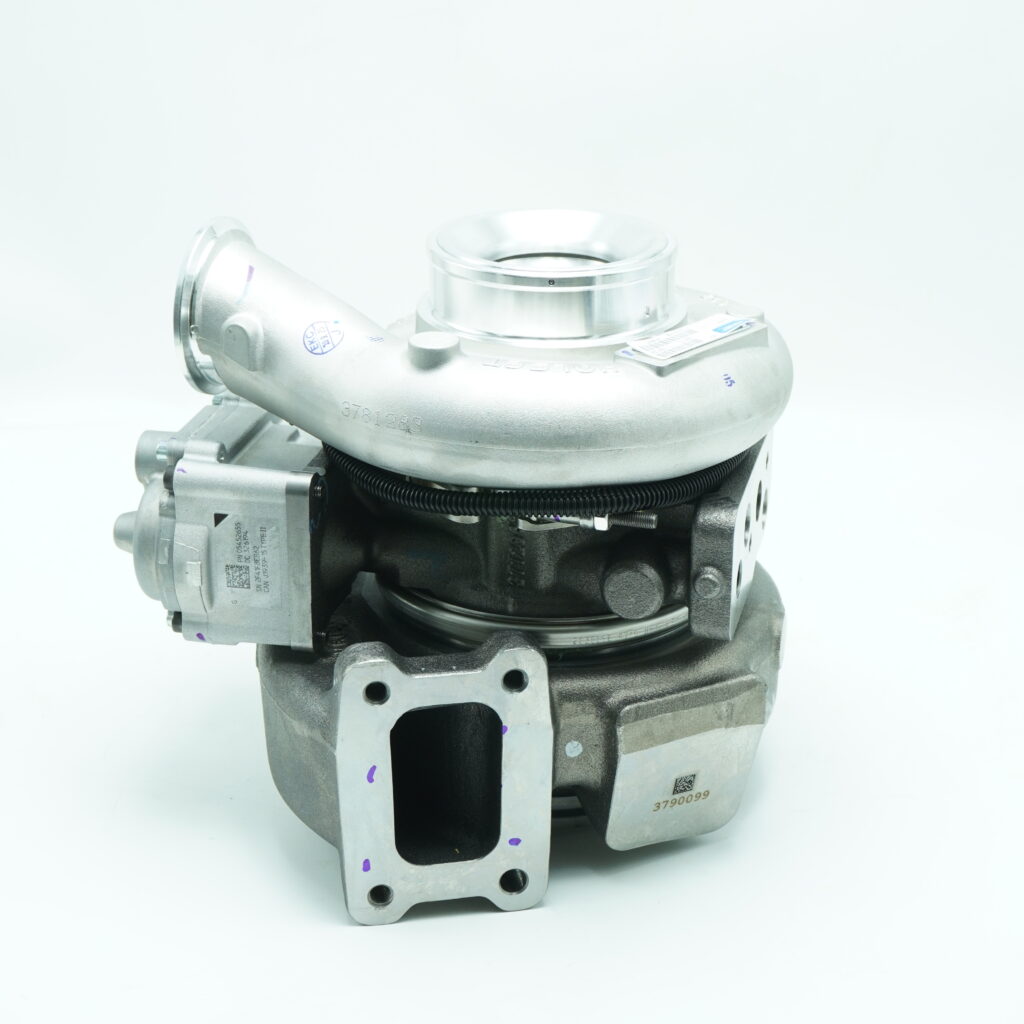
The turbocharger in a Cummins engine works in conditions no other part would survive for long: the wheel spins at around 100,000–200,000 rpm, and on the turbine side it is surrounded by exhaust gas hotter than 600 °C. The only thing standing between the shaft and seizure is a thin film of oil. That is why a turbo very rarely fails “on its own” — it is almost always the victim of something else: dirty oil, a clogged air filter, a leaking intake or poor operating practice.
That is good news. If you learn to read the symptoms early enough, you will usually replace just the turbocharger — instead of the turbocharger, the injectors and the catalyst all at once.
7 signs of a worn turbocharger
1. Blue smoke from the exhaust
The most characteristic symptom. Bluish, acrid smoke means the engine is burning oil — and with a worn turbo, oil gets past the worn shaft seals into the intake or the exhaust. The smoke is usually most visible when accelerating after a longer period at idle.
2. Rising oil consumption with no leaks
The oil level drops but the ground under the machine is dry? The oil is escaping “inside”. The turbocharger is one of the first suspects — alongside the piston rings and valve stem seals. A simple test: disconnect the pipe between the turbo and the intercooler and check whether the inside is wet with oil.
3. Whistling, whining or a siren noise when accelerating
A healthy turbocharger makes an even hum. A growing high-pitched whistle that changes with engine speed usually signals shaft play or a leak at an intake joint. A metallic grinding noise is an alarm — switch the engine off immediately, before the wheel rubs against the housing.
4. Loss of power and slower boost build-up
The machine “pulls like a naturally aspirated engine”, the turbo takes a long time to spool and then still does not deliver full boost. On engines with a variable geometry turbo (VGT — used on newer ISB, QSB and ISX units, among others) the cause is often not the wheel itself but a coked-up vane mechanism or a seized actuator.
5. Black smoke under load
Too little air for the amount of fuel means incomplete combustion. Before you blame the turbo, check the cheaper things: the air filter and the tightness of the intake pipes and intercooler. In workshop practice a “turbo failure” very often turns out to be a leaking boost system hose.
6. Shaft play on inspection
A test you can do without removing the turbocharger: take off the intake pipe and grab the compressor wheel nut. Axial movement (along the shaft, “towards and away from you”) should be minimal — noticeable end play means a worn thrust bearing. A little radial play is normal, but the wheel must not touch the housing. If the blades show rub marks, the turbo needs replacing.
7. Boost pressure fault codes
On ECM-equipped units turbo wear sooner or later turns on the warning lamp: codes for intake manifold pressure, VGT actuator position or a mismatch between the requested and actual value. It is the fastest way to tell a mechanical problem from a control problem — how to read these codes is explained in our guide to SPN/FMI fault codes.
Why turbochargers fail — four main causes
- Neglected oil and filtration. The most common cause we see. Contaminated oil destroys plain bearings within a few dozen operating hours. Regular oil and filter changes cost an order of magnitude less than a turbo.
- Oil starvation at start-up. Full throttle straight after starting a cold engine means the turbo spools up before the oil reaches it. A few seconds at idle after starting is the cheapest insurance an operator has.
- Foreign object in the intake or exhaust. A piece of gasket, a bolt, a bit of filter — at 150,000 rpm a tiny particle is enough to chip the blades and unbalance the wheel.
- Shutting down a hot engine abruptly. After heavy work the turbine is hot; switching off immediately stops the oil flow, and the oil bakes in the bearing housing. The result is carbon deposits and a seized bearing. 2–3 minutes at idle before shutdown really does extend turbo life.
Rebuild or replace? Practical criteria
A rebuild can make sense — provided it is done by a workshop with a balancing machine that replaces the full set of wear parts (bearings, seals, shaft-and-wheel if needed). A few pointers from practice:
| Situation | Recommendation |
|---|---|
| Normal wear, housings not cracked | rebuild or new — price and lead time decide |
| Broken/chipped wheel, rub marks on the housing | replace |
| VGT turbo with coked geometry but a sound shaft | cleaning/rebuild can pay off |
| Failure after an engine seizure or “metal” in the oil | replace + clean the whole intake |
| Machine critical to production, time is what counts | new part from stock — availability wins |
The cost calculation has one more component that is easy to forget: the cost of a second removal. If a rebuilt turbo fails after a few hundred hours, you pay for the labour twice, plus another period of machine downtime.
Before you fit a new turbocharger — 5 things to do
A new turbo fitted to a dirty system fails again. Before you bolt everything back together:
- Find the cause of the first failure. If it was oil starvation, the new part will share the fate of the old one.
- Clean or replace the oil feed line. A coked feed line is a classic killer of “new” turbos.
- Check that the crankcase breather is clear. Increased crankcase pressure pushes oil past the turbo seals — and it looks exactly like a turbo failure.
- Clean the whole intake and the intercooler. Remaining oil and metal particles go straight back into the cylinders.
- Prime the bearing housing with oil before the first start and start the engine without touching the throttle.
How to choose the right turbocharger for a Cummins engine
Turbochargers on Cummins engines are most often supplied by Holset — a brand belonging to the group, so a “Holset turbo” and a “Cummins turbo” are usually the same part in different packaging. The same engine model may, however, have received different turbo variants depending on application and power rating, which is why matching “by engine model” is unreliable. Reliable sources are:
- the number on the turbocharger plate (on the housing, often with a type designation such as HX25, HX35, HE351) — type it into the search on our website; we handle superseded numbers and replacements,
- the engine serial number (ESN) — based on it we match the part to that specific engine; how to find it is explained in our guide Cummins ESN — where to find the engine serial number,
- a photo of the old turbo and its plate sent via WhatsApp: +48 728 626 259.
In the turbochargers category you will find parts for the popular B and C series and for industrial engines; alongside complete turbos we also stock boost system hoses and actuators. Every product page lists the alternative numbers — turbo 2843145, for example, also appears as 4033826, 2843156 or HX25W.
It is worth ordering the manifold and oil line gaskets at the same time — a small cost that saves a second removal. You will find them in the manifold gaskets category.
Availability and lead time
Some turbochargers are in stock in our warehouse in Poland and ship within 24–48 h. Items ordered in for you typically take 7–10 working days. Before you buy we always confirm the lead time for the specific part number — call us or write via the contact form and plan machine downtime without surprises.
Summary
Blue smoke, disappearing oil, whistling, loss of power, shaft play and boost pressure codes — the more of these symptoms appear together, the more certain the diagnosis. But remember the most important rule: the turbocharger is usually the victim, not the culprit. Replacing it without finding the cause is the most expensive way to repeat the same failure a few months later.
Need help choosing? Give us the number from the turbo or the engine ESN — phone/WhatsApp +48 728 626 259 or the contact form.