An accessory drive belt costs less than an hour of work for most machines. And when it snaps in the field, it stops the water pump, the alternator and the fan at the same time — in other words cooling, charging and, in practice, the whole machine. There is no other part on a Cummins engine with such a favourable ratio of price to the consequences of failure.
The good news: checking the belt and tensioner takes ten minutes and needs no tools. It is worth making it part of your routine inspection.
What the belt drives — and why a broken belt is dangerous
On a typical Cummins engine one serpentine (poly-V) belt drives several components at once: the water pump, the alternator, the radiator fan, and on many machines also an air compressor or an air-conditioning compressor.
The consequences of a break are therefore a cascade: the engine stops being cooled and overheats within minutes, the battery stops charging, and if the belt drove a compressor, the air system goes too. That is why a broken belt is not a “limp to the workshop” fault. It means stopping the machine immediately.
A 10-minute inspection: what to look for
Safety: carry out every inspection with the engine off and the key removed.
1. Cracks across the ribs
A few small cross-cracks per metre of belt are normal ageing. Dense or deep cracks, or cracks running across several ribs at once, mean replacement. Bend the belt backwards — this reveals cracks you cannot see when it is straight.
2. Missing material and delamination
Chunks missing from the ribs, a peeling tension layer, frayed edges — replace the belt without discussion. Wear on one edge also points to pulley misalignment (see below).
3. Glazed, “polished” side surfaces
A glassy shine on the sides of the ribs is a sign of slipping. The belt has lost its grip — it will squeal and will not transmit full torque, even if it looks intact.
4. Traces of oil or coolant
Oil attacks rubber and makes it swell. Before you replace the belt, find the source of the leak — otherwise the new belt will wear out just as fast.
5. Tensioner arm and roller bearings
With the belt off: the tensioner arm should move smoothly and return firmly, without sticking or side play. Turn the rollers by hand — roughness, resistance or an audible grinding means a worn bearing. Also check the arm position indicator if the tensioner has one: a position outside the working range means the belt is stretched or the tensioner is worn.
6. Pulley alignment
Hold a straight edge against the faces of the pulleys — they should lie in one plane. Any deviation means a worn bearing, a bent bracket or an incorrectly fitted part. A new belt on a misaligned drive will wear out within a few dozen hours.
Symptoms during operation
| Symptom | Most likely cause |
|---|---|
| Squeal at start-up or when a load is switched on | belt slipping — wear, oil or low tension |
| Constant squeal rising with engine speed | worn roller or tensioner bearing |
| Whining / grinding at the front of the engine | tensioner, idler or water pump bearing |
| Shaking, “jumping” tensioner arm | worn tensioner or stretched belt |
| Poor battery charging | belt slipping on the alternator pulley |
| Overheating under load | belt slipping → water pump turning too slowly |
| Black dust under the accessory drive | heavy belt wear — check the alignment |
If you see overheating, check the belt at the start of the checklist — it is one of the cheapest possible causes. The full diagnostic order is described in our guide to Cummins engine overheating.
The tensioner — why it is replaced together with the belt
An automatic tensioner has a spring and a bearing that wear over time just like the belt rubber. A weakened spring means too little pressure — slipping, squealing and faster wear of the new belt.
Rule of thumb: at the second belt change, replace the tensioner, and at the first one check it carefully. If the arm shakes while the engine is running (watch from a safe distance), the tensioner can no longer damp the vibration and needs replacing regardless of hours.
Tensioners are in the belt tensioners category — e.g. 3104028 (alternatives 3100202, 3102040) or 3936213. While you are at it, check the idlers and rollers — they belong to the same “wear family”.
How to choose the right belt
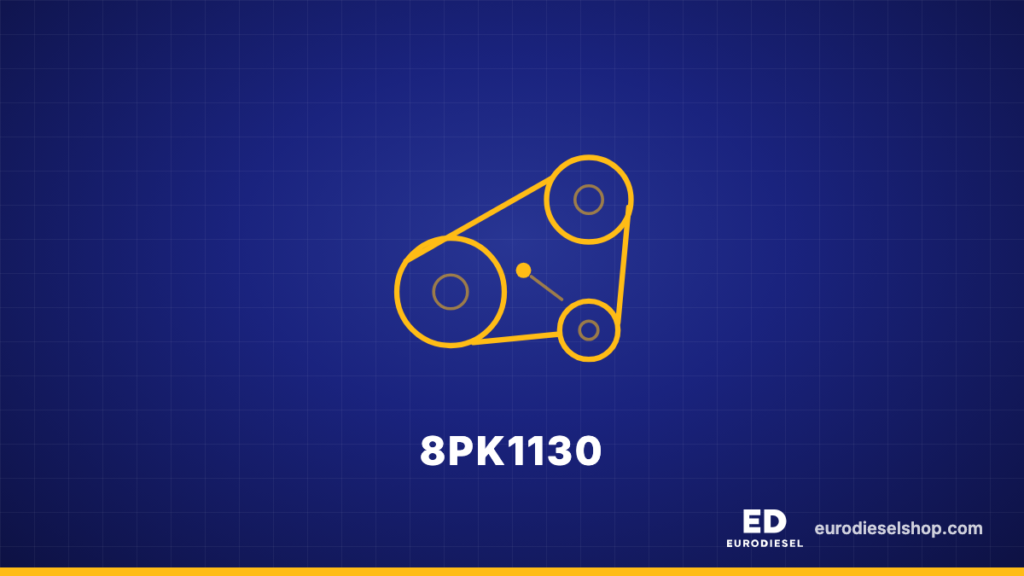
A serpentine belt is described by two numbers, usually in the format 8PK1130:
- 8 — the number of ribs,
- PK — the profile (the poly-V rib standard),
- 1130 — the length in millimetres.
The same engine in different machines can have different belts, because the set of driven accessories varies — with or without air conditioning, with or without a compressor. That is why matching “by engine model” is unreliable. Reliable routes:
- the Cummins part number from the old belt or the documentation — type it into the search; we handle superseded numbers and replacements (e.g. belt 3288554 also appears as 8PK1130),
- the size marking on the back of the belt (such as 8PK1130) — if the Cummins number is no longer legible,
- measuring the length of the old belt if there are no markings at all — ideally together with a photo of the drive layout,
- the engine serial number (ESN) plus information about the machine’s accessories; how to read the ESN is explained in our guide Cummins ESN number.
The full range is in the belts category.
Fitting — four things people forget
- Sketch or photograph the belt routing before removing it. With five pulleys and an idler, a mistake is very easy.
- Never lever the belt on with a screwdriver — you will damage the tension layer and the belt will break after a few dozen hours. Release the tensioner instead.
- Check the condition of the pulleys. Worn, rusty or dirty grooves destroy a new belt; see belt pulleys.
- Check the tension after the first operating hours. A new belt beds in slightly — that is normal, but worth verifying.
Is it worth keeping a spare belt in the machine?
For machines working in the field — definitely. A belt takes up almost no space, does not deteriorate on the shelf, and not having one means the machine is immobilised immediately and a service call-out. For fleets it is worth keeping one belt and one tensioner in stock for each engine type. It is the cheapest stock item with the biggest effect on machine availability — especially when some items have to be ordered in.
Availability and lead time
Some belts and tensioners are in stock in our warehouse in Poland and ship within 24–48 h. Items ordered in for you typically take 7–10 working days. For fleet orders (several spares) we confirm availability and lead time for the whole list — write via the contact form.
Summary
The belt is the cheapest part whose failure stops the machine immediately — and one of the few you can assess by eye in a few minutes. Look for cracks across the ribs, glazed sides and traces of oil, check the tensioner arm and pulley alignment, and when ordering go by the part number or a marking such as 8PK1130 — not by the engine model alone. A spare belt in the machine is the cheapest insurance against downtime you can buy.
No legible number on the old belt? Send a photo of the drive and give us the engine ESN — phone/WhatsApp +48 728 626 259 or the contact form.