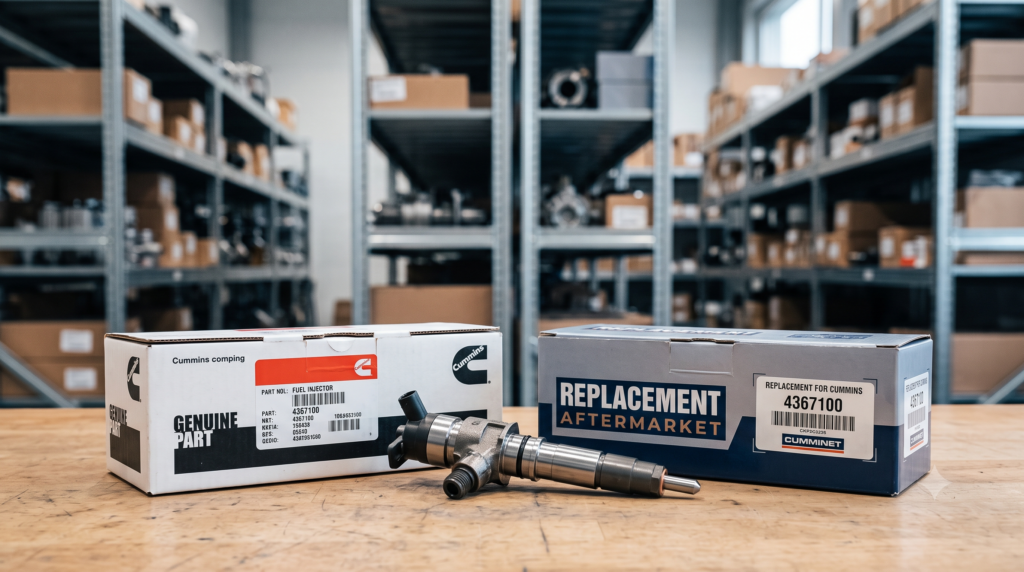
“Should I buy genuine or aftermarket?” — we hear this question every day. And every day we give the same answer: it depends on the part, the age of the engine and how much an hour of machine downtime costs you. This guide explains the difference between genuine, OEM and aftermarket parts, decodes the mysterious part number suffixes (RX, NX) and shows where saving money makes sense — and where it ends with a second bill for repairing the repair.
Three types of parts — what they really mean
Genuine Cummins part
A part in Cummins packaging, with the engine manufacturer’s part number and covered by its quality control. A fact that is often overlooked: Cummins does not make every component itself — filters, for example, come from Fleetguard and turbochargers from Holset, both part of the group. “Genuine” therefore mainly means guaranteed compliance with the factory specification and certainty that you get exactly what left the assembly line.
OEM part (from the original equipment supplier)
The same factory that makes the component for first fit also sells it under its own brand — usually for less, because there is no engine manufacturer’s logo on the box. Classic examples in the Cummins world are Fleetguard (filtration) and Holset (turbochargers). In terms of quality it is the same part; the differences are price, packaging and warranty terms.
Aftermarket replacement
A part made by a third party based on the specification or on reverse engineering. This is where quality varies the most: from very good replacements from reputable brands to products whose only advantage is the price. Not all replacements are equal — what matters is who made it and who stands behind it. In our shop every product page clearly states the type of part, so you always know what you are buying.
Part number suffixes: RX, NX and superseded numbers
Browsing our products, you will see several numbers for one part, e.g. an injector with a base number and variants ending in RX or NX. These are not typos:
- RX — a part remanufactured at the factory under the Cummins ReCon programme (full factory remanufacturing with replacement of wear components, tested like new),
- NX — a new part offered under the exchange programme,
- superseded numbers — Cummins regularly revises designs; the old number is then replaced by a new one. A part with the “new” number fits in place of the old one, although it may be priced differently.
So if your part number “doesn’t exist” online, it has most likely been superseded. Our product pages list alternative numbers, and the search finds the part by its old number too. Can’t find yours? Give us the number or the engine ESN — we will check the supersession chain in the factory catalogues.
When a genuine part is worth paying more for
For some groups of parts the saving is illusory, because the cost of getting it wrong is many times higher:
- Fuel injection system — injectors and injection pumps work to tolerances of thousandths of a millimetre. A poor replacement can burn a piston — the repair costs many times the “saving”.
- Control modules and electronics — engine control modules (ECM) and key sensors. Cheap electronics are a lottery: wrong readings can mimic mechanical faults for weeks.
- Turbochargers — with turbochargers a wheel failure often ends with metal in the intake and further damage.
- Internal engine parts during a rebuild — bearings, pistons, liners. You rebuild an engine once; the difference in parts price is spread over thousands of operating hours.
When a good aftermarket part is the sensible choice
- Filters and consumables — here the line blurs anyway, because branded filtration (e.g. Fleetguard) is in fact OEM. What matters is sticking to the change intervals — see our oil filters and fuel filters.
- Gaskets, O-rings and simple mechanical parts — gaskets and seals from reputable manufacturers perform without problems.
- Older, lower-value engines — for a worn unit that only needs to see out the season, the economics often favour a replacement.
- Cooling system components — water pumps, thermostats and belts from good aftermarket brands are standard in fleets all over the world.
Genuine vs aftermarket — quick comparison
| Criterion | Genuine / OEM | Good aftermarket |
|---|---|---|
| Compliance with specification | guaranteed | usually yes, the manufacturer needs checking |
| Price | higher | lower |
| Warranty | engine manufacturer / OEM supplier | seller and replacement manufacturer |
| Risk with precision parts | minimal | grows with the precision of the part |
| Typical use | injection, electronics, turbo, rebuilds | filters, seals, ancillaries |
Availability and lead time — plan downtime wisely
Whether you choose genuine or aftermarket: some items are in stock in our warehouse in Poland and ship within 24–48 h, while parts ordered in for you typically arrive in 7–10 working days. For planned repairs it pays to order parts in advance — we confirm the exact lead time for a specific part number before you buy, so you know when to book the mechanic and the operator.
Summary
There is no single right answer to “genuine or aftermarket” — there is a right answer for a specific part in a specific engine. Rule of thumb: the more precise the part and the more expensive the consequences of its failure, the stronger the case for genuine or OEM; for consumables and simple ancillaries, a good replacement is sound economics.
Don’t want to guess? Give us the part number or the engine ESN — we will recommend the option, quote the price and a realistic lead time. Phone/WhatsApp +48 728 626 259 or the contact form.